.webp) reviewgamesh5.com
reviewgamesh5.comThe Phenomenology of the Single-Button Loop: Psychological Weight and Procedural Rhythm in Scarlet Skips

The indie landscape has long harbored a fascination with reductionism—stripping core mechanics down to their absolute barest components to find out what emotional or mechanical resonance can be squeezed from a single input. Developed by Yerk Games, Scarlet Skips presents itself initially as a whimsical, cartoonish casual roguelike centered around the deceptively simple act of rope skipping. Yet beneath its bouncy exterior and expressive Unreal Engine-driven character animations lies a dense, rhythmically obsessive loop that invites deep structural analysis. Rather than treating the single button as a limitation, the game turns the press-hold-release paradigm into a philosophical instrument of pacing, tension, and release, mimicking the broader existential weight of modern repetitive loops in digital spaces.
To understand the game's cultural footprint and mechanical gravity, one must look past the surface layer of memes and community reception to examine how it constructs its internal clockwork. Every facet of the game—from the way Scarlet’s depression-fueled narrative premise motivates her quest to "touch grass" to the compounding mathematics of its upgrade cards—operates on a precise thermodynamic exchange of momentum. This deep dive explores the historical trajectory of single-button mechanics, the physics of verticality within a constrained horizontal plane, and the intricate psychological contract established between the player and Scarlet’s perpetual motion.
The Genesis of Reductionism in Modern Indie Design
The lineage of one-button games stretches from early arcade experiments to mobile hyper-casual phenomena, but Scarlet Skips positions itself differently by injecting roguelike progression structures into the mix. Historical antecedents like Flappy Bird or Canabalt taught players that a single binary input could generate infinite tension through variable spacing and gravity. However, Yerk Games introduces a temporal charging mechanic—press, hold, and release—that transforms the binary click into an analog accumulator of intent. This evolution changes the player's relationship with time, shifting them from reactive scrambling to deliberate anticipatory calculation.
This design philosophy reflects a broader movement in contemporary game development toward hyper-focused mechanics that reject combinatorial bloat. By restricting the player to a single point of interaction, the developers force an acute awareness of micro-timing that traditional multi-button platformers often obscure. The reduction of control surface area acts as a magnifying glass, exposing the raw friction between human cognitive response times and predictable computational loops. Consequently, the game’s early moments establish a psychological rhythm that trains the player’s nervous system to synchronize with Scarlet’s breathing and bouncing patterns.
Furthermore, this minimalist approach serves as a brilliant framing device for the game's underlying thematic tone. The character of Scarlet, conceived as an animator's mascot navigating a heavy emotional funk, finds her physical confinement mirrored in the single-button constraint. Every jump is an uphill battle against inertia, a deliberate physical effort required to break out of stagnant emotional valleys. Through this lens, the reductionist controls cease to be merely an arcade conceit and instead emerge as a poignant metaphor for the Sisyphean nature of overcoming mental inertia in everyday life.
The Psychopathology of the Mascot: Scarlet’s Emotional Core
Video game mascots traditionally embody unbridled power, speed, or heroic optimism. Scarlet subverts this archetype entirely by being explicitly depressed, sluggish, and reluctant, framed within a narrative pretext of simply trying to "touch grass" and break free from a domestic funk. This characterization is not just narrative flavor text; it is deeply woven into the animation priority system. The juxtaposition between her melancholy demeanor and the hyper-exaggerated, elastic cartoon physics creates a distinct tonal dissonance that captivates the player's empathy.
The emotional weight of the experience hinges on this behavioral contrast. When Scarlet misses a skip or stumbles, the animation does not merely display a standard failure state; it lingers on her deflation, turning a routine game-over screen into an intimate moment of shared exhaustion. This systemic vulnerability fosters an unconventional protective instinct in the player. We are not just chasing a high score for leaderboard dominance; we are coaxing a tired avatar through a relentless physical ordeal, transforming each successful jump into a micro-triumph over despair.
This integration of character psychology into core gameplay loops highlights a sophisticated understanding of emotional pacing. By grounding a frantic, high-stakes action roguelike in a relatable human struggle against lethargy, the game bridges the gap between mechanical execution and affective storytelling. Players find themselves projecting their own daily frustrations onto the rope's cadence, making the rhythmic act of jumping a form of cathartic processing. The character thus ceases to be pixels on a screen and becomes a mirror for the player's own cycles of burnout and resilience.
The Engine of Expression: Unreal Physics and Procedural Mirth
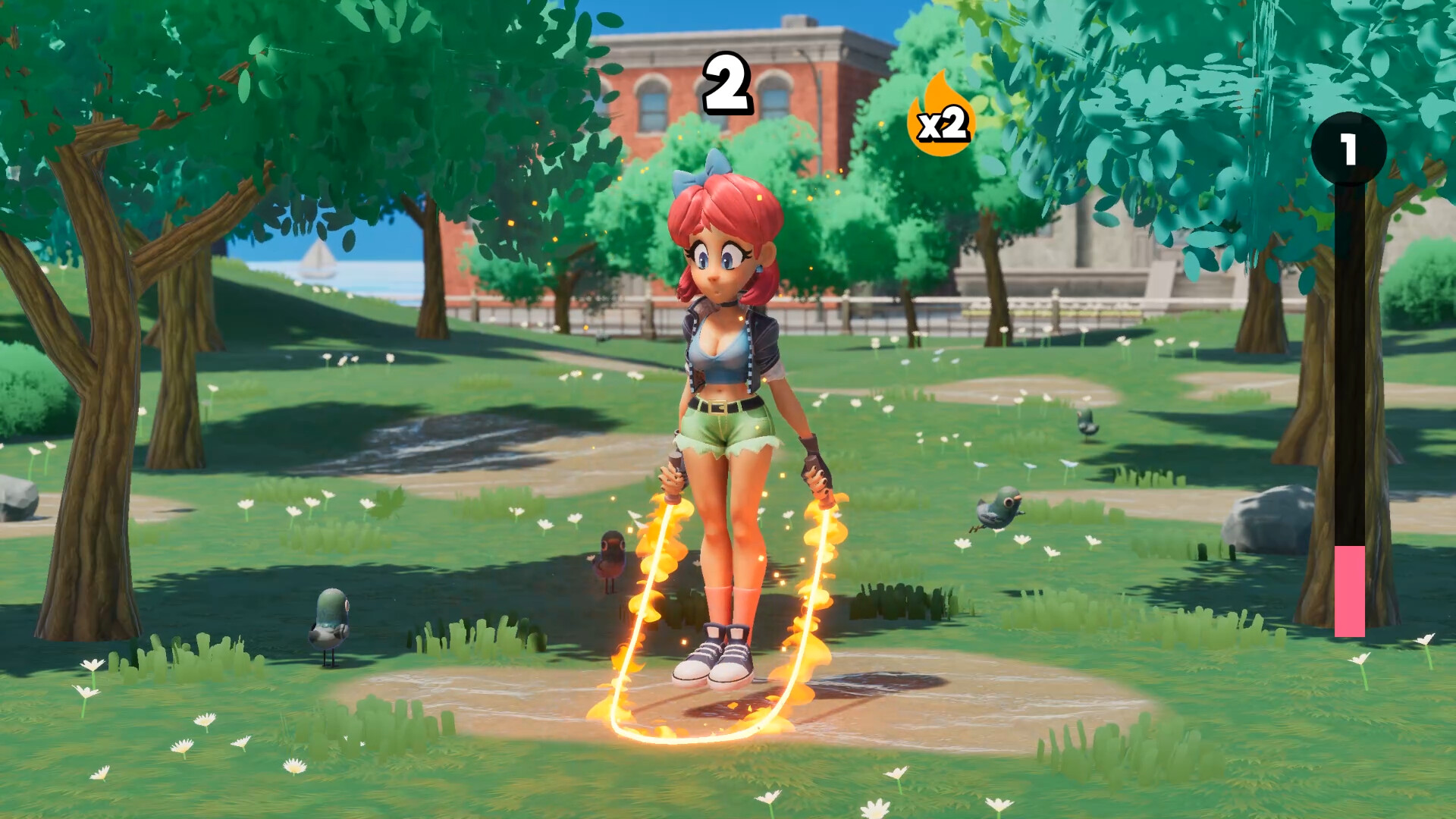
Behind the deceptive simplicity of Scarlet Skips lies a robust technical foundation built within Unreal Engine, utilizing advanced animation tools to blend candid hand-crafted frames with logic-driven procedural movement. This hybrid approach ensures that Scarlet’s body reacts dynamically to environmental conditions, scaling height, stretch, and squash variables in real time based on the player’s input duration and current upgrade stack. The result is an animation pipeline that feels endlessly fluid, avoiding the robotic stiffness often found in minimalist indie titles.
The physics engine plays a crucial role in maintaining this illusion of organic momentum. The rope is not a static collider; it possesses simulated tension and arc curvature that shifts depending on whether modifiers like fire or multiplicative weights are applied. Every bounce generates micro-adjustments in the background set-dressing and camera framing, creating a visceral sense of impact. This attention to kinetic feedback turns what could have been a monotonous visual loop into an evolving spectacle of cartoon physics where scale and velocity distort dynamically.
Moreover, the technical execution directly impacts the mechanical readability of the game. In a title where split-second timing dictates survival, visual clarity is paramount. The developers use squash-and-stretch principles derived from classic animation theory to telegraph upcoming jump windows well before they occur, allowing players to internalize rhythm through visual anticipation rather than raw UI overlays. This seamless marriage of technical fidelity and artistic expression elevates the game from a simple joke concept into a masterclass in responsive, tactile game feel.
The Roguelike Layer: Arithmetic Escalation and Build Diversity
While action-oriented jumping games typically rely on fixed level progression, Scarlet Skips introduces a rogue-like upgrade economy where players choose from three random power-ups between milestone thresholds. With a pool of ten fundamental upgrade cards—ranging from simple jump-height enhancements to adding extra ropes or setting the equipment ablaze—the game shifts from a test of pure reflexes into an exercise in tactical optimization. Players must evaluate their current run state and choose upgrades that synergize with their preferred pacing.
This upgrade system creates a fascinating dynamic of exponential escalation. Early game tiers require careful, measured inputs to clear standard obstacles, but late-game builds transform Scarlet into an unstoppable acrobatic engine capable of screen-clearing maneuvers. The ability to stack modifiers leads to emergent, unintended mechanical behaviors that reward creative experimentation. Players quickly learn to value specific card combinations, tailoring their approach to either maximize safety or push reckless velocity for score multipliers.
However, this arithmetic escalation also introduces delicate balancing acts within the design structure. Because upgrades can be combined into virtually infinite configurations, the game continually tests the structural integrity of its own physics engine. Unforeseen synergies can break standard encounter spacing, forcing players into hyper-chaotic states where visual processing reaches its absolute limit. This embrace of controlled chaos is precisely what gives the roguelike loop its addictive replayability, ensuring no two runs ever feel identical despite the unchanging core action.
Temporal Mechanics: The Architecture of Rhythm and Flow
Time in Scarlet Skips is not measured in minutes or seconds, but in rotations, beats, and kinetic pulses. The rope’s rotation acts as an internal metronome that dictates the player’s cognitive tempo. By tying the primary interaction to a press-and-hold duration, the game forces the player to internalize a complex temporal subdivision system. You aren’t just reacting to a visual cue; you are predicting the apex of an invisible parabola and aligning your motor output with the metronomic swing of the rope.
This strict adherence to temporal rhythm induces a state of deep psychological flow. When a player achieves synchronicity, external distractions fade away, replaced by a hyper-focused trance state characterized by seamless hand-eye coordination. The audio-visual design reinforces this state, layering rhythmic sound effects that punctuate each successful skip, creating a feedback loop of positive reinforcement. Every "boing" functions as a sonic anchor, cementing the player's immersion within the game's internal clockwork.
Conversely, breaking this rhythm shatters the flow state instantly, producing a sharp spike of cognitive dissonance. Because the penalty for mistiming is immediate and absolute, the temporal architecture demands total mindfulness. Players cannot coast on autopilot for long without facing severe consequences. This constant oscillation between serene flow and abrupt, high-stakes tension forms the heartbeat of the experience, keeping the nervous system engaged and preventing the mechanical loop from ever feeling stale.
Spatial Economy: Scaling Verticality on a Flat Plane
Despite taking place within a tightly bounded vertical slice, Scarlet Skips masters the illusion of infinite vertical ascent through clever spatial composition. The screen acts as a staging ground where horizontal positioning is largely abstracted away, concentrating all spatial awareness entirely on the vertical axis and depth cues. Background set-dressing updates progressively, giving the psychological impression of leaving the mundane indoor funk behind and soaring toward celestial heights.
This vertical economy transforms the play space into a vertical tower of risk and reward. As the jump height increases via upgrades, the camera must dynamically adjust its focal length, altering the player's perception of scale. What begins as an intimate, ground-level exercise in rope-clearing quickly escalates into vertigo-inducing heights where timing windows shrink relative to the increased velocity of the fall. The spatial compression forces the player to look ahead across multiple cycles, planning their trajectory long before their feet leave the ground.
The brilliance of this spatial design lies in its clarity. By stripping away extraneous platforming variables like horizontal navigation, level architecture, or environmental hazards, the game directs 100% of the player's spatial reasoning toward temporal-vertical calibration. Every pixel of vertical displacement carries immense mechanical weight. This extreme focus turns a simple screen-space constraint into a canvas for precision acrobatics, proving that deep spatial mastery does not require sprawling 3D environments.
The Paradox of Frustration: Designing for Meaningful Failure
In modern arcade-style design, frustration is often treated as a toxic byproduct of cheap difficulty. Scarlet Skips approaches frustration differently, weaponizing it as a narrative and emotional tool. Because Scarlet’s entire premise is rooted in overcoming a depressive funk, failure carries narrative resonance. When a run ends prematurely due to a minor input error, it mirrors the real-world frustration of taking two steps forward and one step back.
This design philosophy fosters a unique relationship with failure, steering players away from controller-throwing rage and toward reflective amusement. The game’s exaggerated animations and self-aware tone ensure that even the most agonizingly close failures are met with a chuckle rather than despair. Failure is framed not as a permanent block, but as a natural part of the rhythmic cycle—a prompt to catch your breath, reset your mindset, and try another sequence.
Consequently, the drive to retry becomes intrinsically motivated rather than extrinsically coerced. The player does not return to the game to grind for an arbitrary currency or unlock a cosmetic skin; they return to restore Scarlet's momentum, to prove that this time, the rhythm can be sustained a little longer. This psychological resilience transforms every playthrough into a personal narrative of persistence, aligning the player’s emotional arc directly with the character's thematic objective.
Community Lore and the Emergence of Self-Imposed Metagames
No indie release exists in a vacuum, and Scarlet Skips quickly cultivated a passionate community that transformed its simple mechanics into a canvas for community-driven challenges and specialized subcultures. Beyond chasing standard leaderboards, players began inventing self-imposed limitations—such as zero-upgrade runs, baseline-only speedruns, or endurance runs designed to test the absolute psychological limits of rhythmic concentration. These player-made rules inject infinite longevity into a game with a relatively compact baseline scope.
This organic community engagement highlights the power of transparent, unpretentious game design. Because the ruleset is entirely transparent and free of hidden RNG traps outside of the card selection pool, players feel a strong sense of ownership over their mastery. Sharing specific build configurations or discussing optimal timing strategies on forums creates a shared cultural lexicon centered around Scarlet’s perpetual bouncing. The game functions less as a closed commercial product and more as an open playground for community experimentation.
Furthermore, the viral nature of the game’s mascot and expressive animation style has cemented its place in contemporary internet culture. The juxtaposition of an adorable YouTube channel mascot undergoing existential dread while skipping rope provided fertile ground for artistic expression, fan animations, and meme culture. This cultural spillover amplifies the game's impact, proving that tight, highly stylized indie mechanics coupled with a memorable character can punch far above their weight class in the digital zeitgeist.
The Socio-Cultural Mirror: Escapism Through Absurdist Repetition
At its core, Scarlet Skips captures a distinct mood of modern digital escapism—finding comfort in absurd, repetitive loops when reality feels overwhelming. The act of skipping rope infinitely is inherently absurd, yet the dedication required to master it mirrors the repetitive rituals humans use to cope with daily anxiety. By framing this absurdity through a cute, expressive lens, the game offers a safe sandbox where players can channel their restless energy into a tangible, rhythmic output.
This socio-cultural resonance explains why minimalist, single-button titles frequently achieve cult status. In an era dominated by hyper-complex open worlds and overwhelming systemic demands, a game that asks you to do only one thing—and do it rhythmically well—feels like a mental sanctuary. It cuts through cognitive fatigue, offering an immediate feedback loop that rewards focused presence. You cannot think about taxes or deadlines while timing a fiery rope rotation at terminal velocity; you can only exist in the present moment.
Ultimately, the game acts as a mirror for our collective desire for simple progression. Life is complicated, messy, and frequently frustrating, but Scarlet’s world reduces existence down to its purest binary: jump or don't jump, move forward or stay stuck. By helping her touch grass, players indirectly participate in their own small act of digital grounding, finding poetry in the bounce, catharsis in the failure, and joy in the relentless, beautiful absurdity of the skip.
Conclusion: The Lasting Echo of the Single Bound
Scarlet Skips proves that profound mechanical depth and emotional resonance do not require sprawling budgets or complex control schemes. By marrying a minimalist single-button input with robust physics, rogue-like arithmetic escalation, and a deeply endearing character study, Yerk Games has crafted an experience that lingers long after the game is closed. It stands as a testament to the power of focus in game design—proving that when you restrict the player's options, you expand their appreciation for every single micro-interaction.
As the indie sphere continues to evolve, titles like this remind us why we fall in love with interactive media in the first place: for the pure, unadulterated joy of mastering a rhythm. Scarlet’s journey from a stagnant funk to celestial heights is ultimately our own journey—one carefully timed bounce, one stacked upgrade, and one leap of faith at a time. The rope keeps swinging, the counter keeps ticking, and the bounce echoes on.