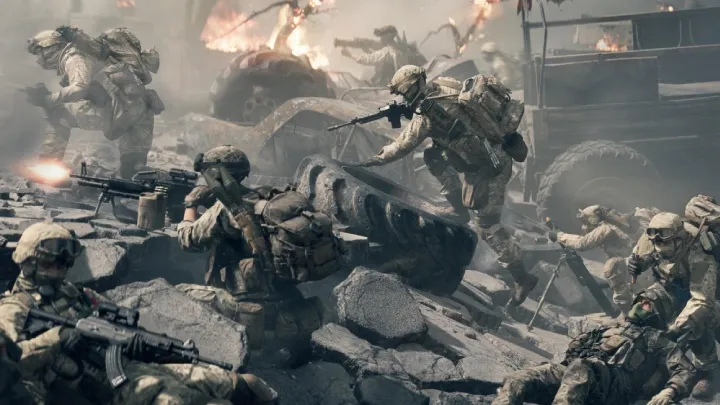








Battlefield is more than just a first-person shooter; it represents a technical milestone in the gaming industry. After the turbulence of previous titles, EA and its partner studios have achieved a spectacular turnaround by returning to modern settings, focusing on traditional player matches, and restoring the core Class system.
However, the true soul that separates Battlefield from its competitors is not the weapon count or the map size, but the destruction system. In this installment, destruction technology has evolved from scripted events into a complex, real-time physical simulation. This article dives deep into the evolution of the Frostbite engine destruction mechanics and how they redefine virtual military tactics.
The Revival of Total Destruction Philosophy from Bad Company
For years, the community hailed Bad Company as the gold standard for leveling maps. Battlefield has officially brought that sensation back, but on a much more sophisticated scale. Instead of having only two states—intact and rubble—every structure in the game now possesses its own unique structural integrity.
The new system allows players to destroy specific wall sections based on the angle and impact force of the projectile. If you fire a rocket at the base corner of a building, gravity actually affects the upper floors, causing them to tilt and collapse naturally. This creates a battlefield that never repeats, where every match is a unique topographical experience.
Micro Destruction Technology Detail Down to the Brick
Beyond collapsing skyscrapers, Battlefield introduces the concept of Micro-Destruction. This is a major leap in the next-generation Frostbite engine, allowing debris, furniture, and small cover materials to react accurately to gunfire.
When a firefight occurs in tight spaces like offices or apartments, players will see plaster peeling, wooden floors splintering under machine-gun fire, and fire extinguishers exploding to create temporary smoke screens. This detail serves a tactical purpose: players can shoot through thin layers of material to eliminate hidden enemies without needing to destroy the entire wall.
Fluid and Gas Physics Systems in Battlefield
A persistent problem in previous FPS games was the interaction between explosions and the surrounding environment. Battlefield addresses this by integrating fluid and gas physics into the destruction process.
For instance, in the Contaminated map, toxic gas can leak through holes in walls created by explosives. If you destroy a partition, the gas flow will change direction based on real-world pressure laws. Similarly, fires can spread through flammable materials, forcing players to think twice before using incendiary grenades in enclosed areas.
The Impact of Destruction on Squad Tactical Gameplay
The ability to destroy almost anything completely changes how squads coordinate. In Battlefield, holding a fortress is no longer a guarantee of victory. A skilled Engineer squad can quickly create new paths by destroying ceilings or side walls to flank the enemy.
Breach and Entry Tactics
- Floor Destruction: Instead of taking staircases—which are often death traps—players can use explosives to blow out the floor of the story above and drop directly onto enemies.
- Creating Sniper Holes: Snipers can now create their own small loopholes in walls to observe without being fully exposed.
Levolution Merging Scripting with Physics
While focusing on free-form destruction, Battlefield retains iconic moments in the form of Levolution. Major events like bridge collapses or landslides no longer occur via a single pre-rendered animation.
Depending on where players apply force, the outcome of the event varies. If a bridge is brought down from one side, the debris will block the river differently than if it were collapsed from the center. This forces land vehicles to constantly find new transport routes, adding tension to Conquest matches.
Performance Challenges Balancing Graphics and CPU
Calculating physics for thousands of pieces of debris in a large player map is a performance nightmare. Battlefield Studios utilized new multi-threading algorithms to share the load between the CPU and GPU.
An Instanced Destruction system allows the game to remember the state of environmental damage without dropping the frame rate. However, players on older hardware still face latency issues when too many explosions occur simultaneously. This is a necessary sacrifice to achieve the realism expected from a true next-gen title.
The Sound of Collapse Ray Traced Audio Systems
It isn't just about the visuals; the audio in Battlefield reacts to destruction. When a building loses a wall section, the acoustic characteristics of that room change instantly. Gunfire will lose its indoor reverb and become dry and echoing, as if in an open space.
The Ray-Traced Audio system simulates how sound waves bounce off different materials. A room filled with concrete rubble sounds entirely different from an intact wooden room. This allows players to locate enemies via sound more accurately than ever before.
The Role of Classes in Battlefield Reconstruction
Where there is destruction, there must be reconstruction. Battlefield elevates the Support Class role with the ability to build temporary Fortifications. Similar to previous systems but more flexible, players can set up barricades, sandbags, and reinforce damaged walls.
Interaction between Engineer and Support
- Structural Reinforcement: Support can repair cracked walls to prevent the total collapse of a building.
- Physical Traps: Engineers can use debris to hide anti-tank mines, turning newly formed chokepoints into kill zones.
Maps and Environments From Cities to Jungles
The destruction system is tuned differently depending on the map type. In urban maps like Hagental Base, destruction focuses on concrete and glass. Meanwhile, in jungle maps, felling trees with artillery creates clearings, removing cover for infantry.
Environmental transformation over time is key. By the end of a long Conquest match, a map that started as a beautiful resort often turns into a wasteland of cratered earth and charred building frames, reflecting the brutality of modern warfare.
The Future of the Shooter Genre Post Battlefield
Battlefield has set a new standard that every subsequent shooter must chase. It proves that technology should not just be used to make images prettier, but to make gameplay deeper. Destruction is no longer a mere visual effect; it is a new design language.
While debates remain regarding the balance between vehicle firepower and structural durability, there is no denying that Battlefield has regained the trust of the fans. It is a testament to how, when a studio listens to the community and focuses on core values, they can create a true digital masterpiece.
Conclusion
Battlefield is the perfect intersection of nostalgia and innovation. By focusing deeply on physics and meaningful tactical destruction, the game has stepped out of the shadow of its predecessors to claim leadership in the military shooter genre.
The battlefield is now more vivid, dangerous, and unpredictable than ever, where every bullet fired leaves a permanent mark on the world.